

Abdul El-Sayed was listed to speak at ISNA. Then Doggy opened the 1991 memorandum and found ISNA at the top of its attachment. I followed the document trail. You can read the full paperwork here, not just the highlighted extracts.
Read the full memorandum yourself
Unmodified 32-page court exhibit, with the Arabic original followed by its English translation. Government Exhibit 003-0085, U.S. v. Holy Land Foundation.
Open the full memorandum (PDF)
Key pages: 21: the hostile passage · 26: organisations and guidance · 32: attachment listing ISNA.
Read the related 2009 court order · Original exhibit source
PDF page numbers count from the beginning of the complete file; the translation has its own printed numbering. The highlighted carousel extracts are crops. The PDF above is unaltered.
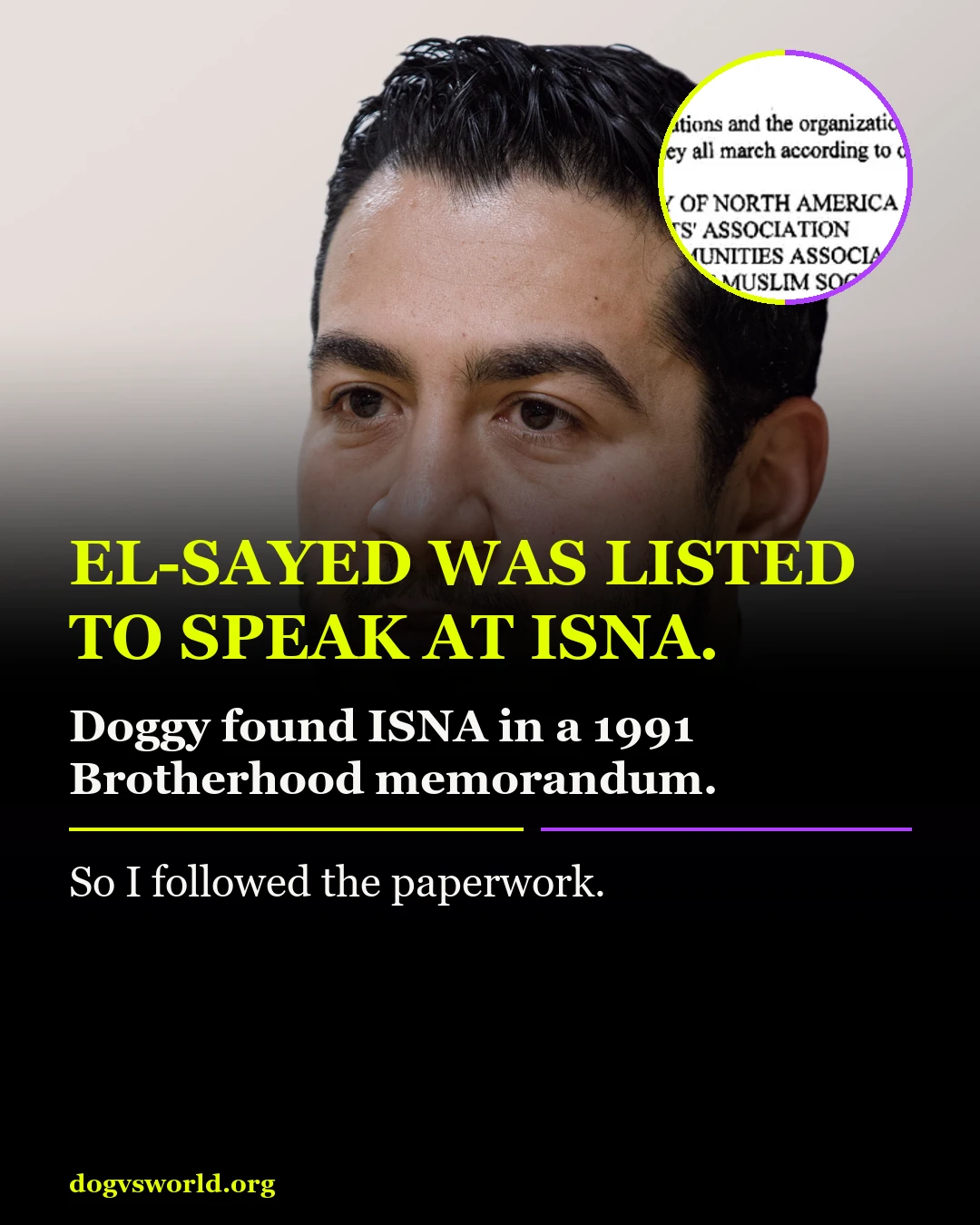
Abdul El-Sayed was listed as a speaker at ISNA's September 4–7, 2026 convention in Detroit. The Islamic Society of North America also appears as the first entry in the attachment to a 1991 memorandum by Mohamed Akram, identified in a federal court order as a member of the Muslim Brotherhood's Shura Council.
Those are two documented facts separated by 35 years. Their significance deserves examination without treating a historical author's plan as proof of a contemporary speaker's beliefs.
The public speaking connection
WDET's September 4 report about the convention names El-Sayed among its speakers and includes an interview with ISNA CEO Azhar Azeez. This establishes a public speaking listing. It does not establish that El-Sayed held an ISNA office or endorsed every position associated with it.
What the memorandum says
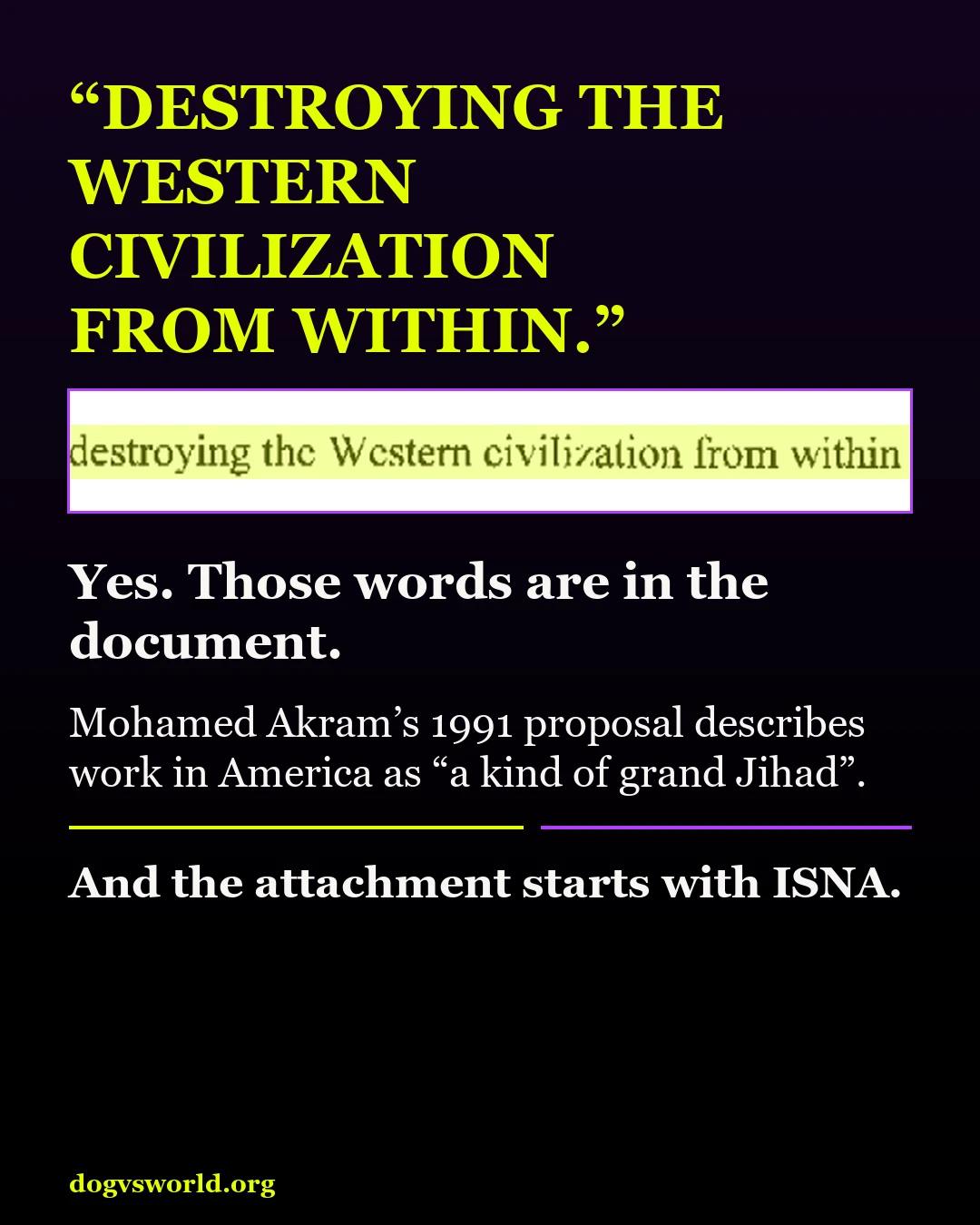
Akram's May 22, 1991 memorandum is preserved as Government Exhibit 003-0085 in the Holy Land Foundation case. Its English translation includes the hostile description of work in America as a grand jihad involving the destruction of Western civilisation from within.
The organisational proposals cover politics, media, education, legal structures and other fields. The author envisages existing institutions as seeds for more comprehensive bodies connected to the movement and following its guidance. The covering text requests discussion and corrections; this is not evidence that every proposal was adopted by every institution named.
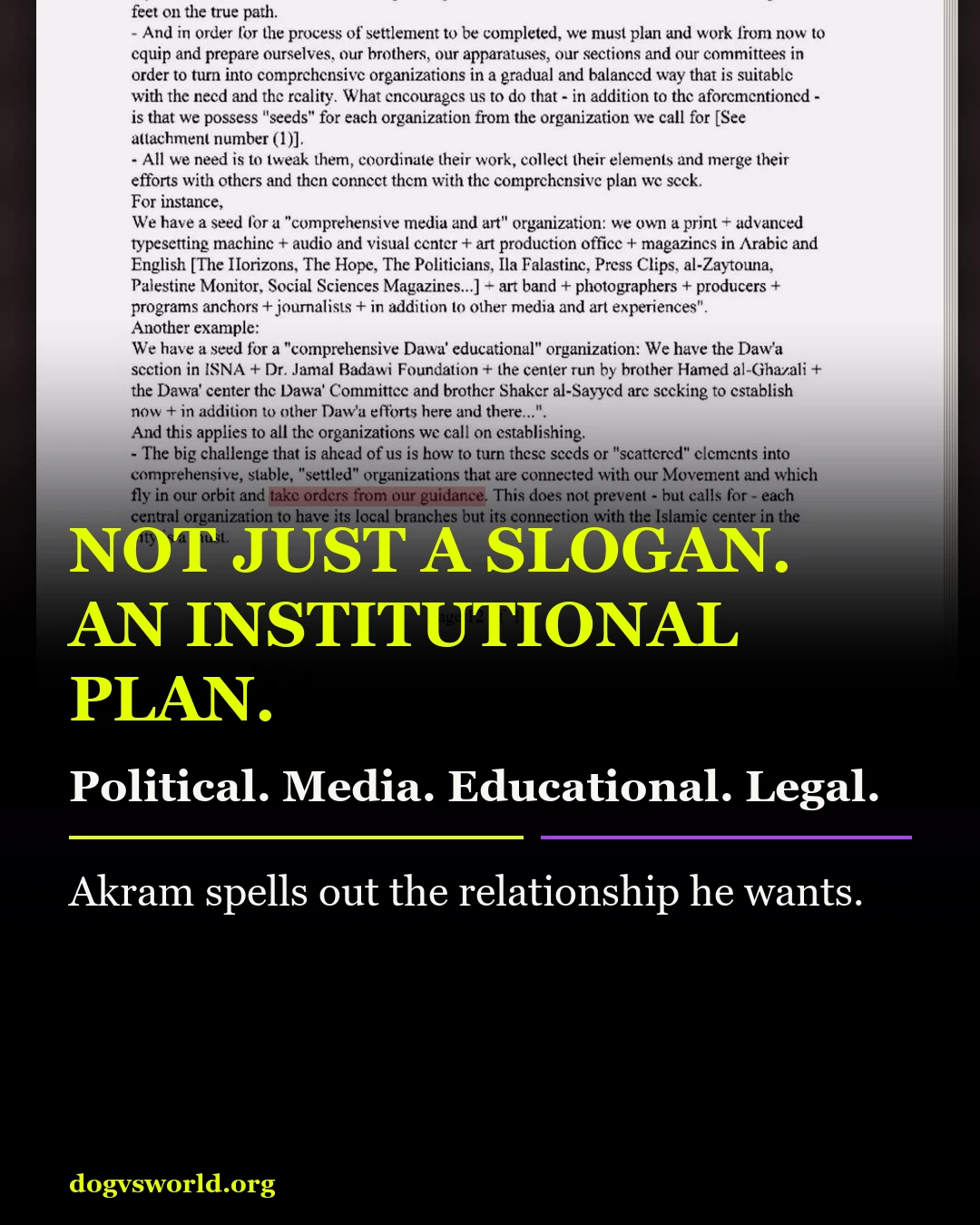
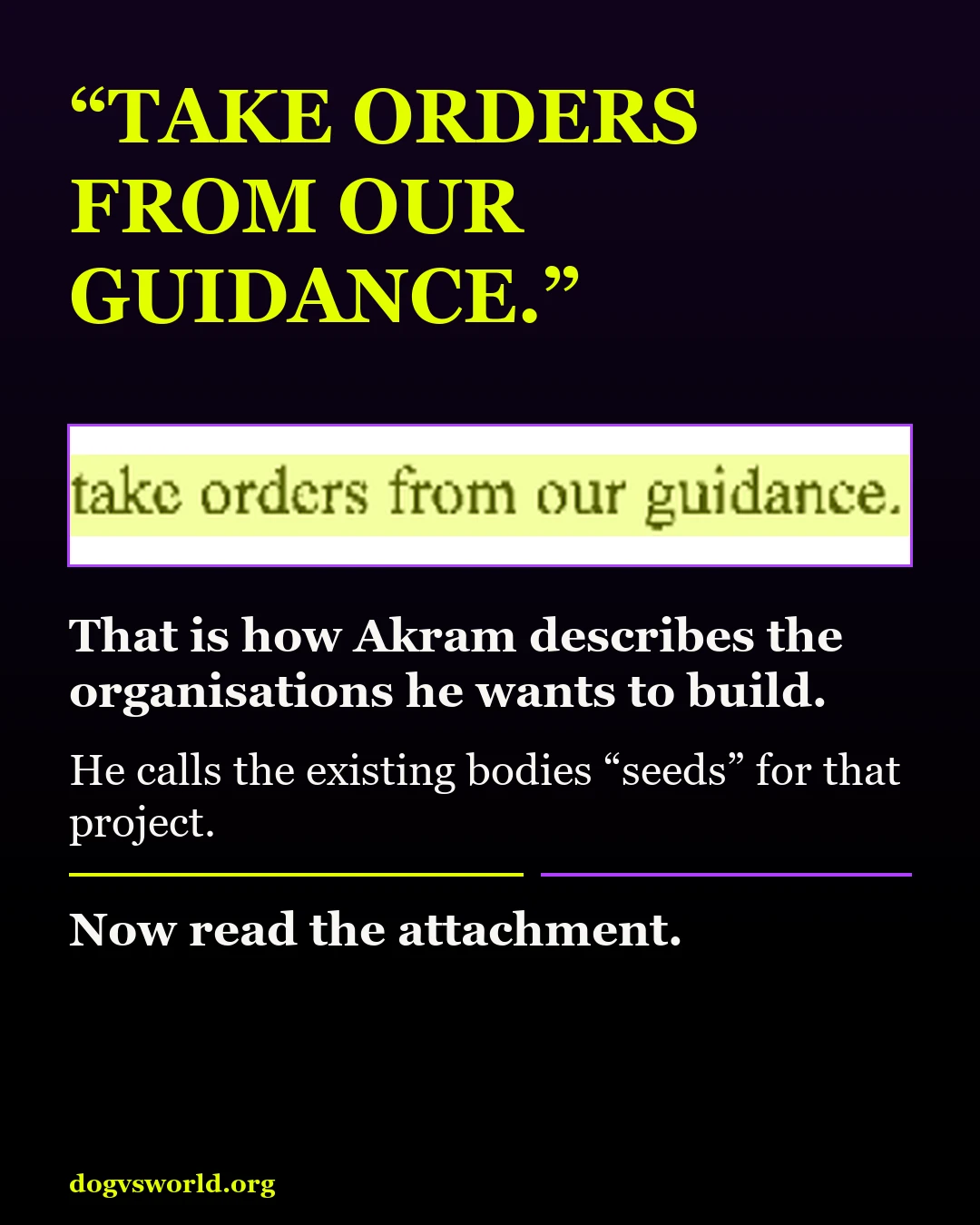
The English translation describes the proposed bodies as following the movement’s instructions: “take orders from our guidance.” See PDF page 26, printed English page 12. The detailed institutional proposals follow on PDF pages 28–31.
Original exhibit · Readable transcription
ISNA's place in the attachment
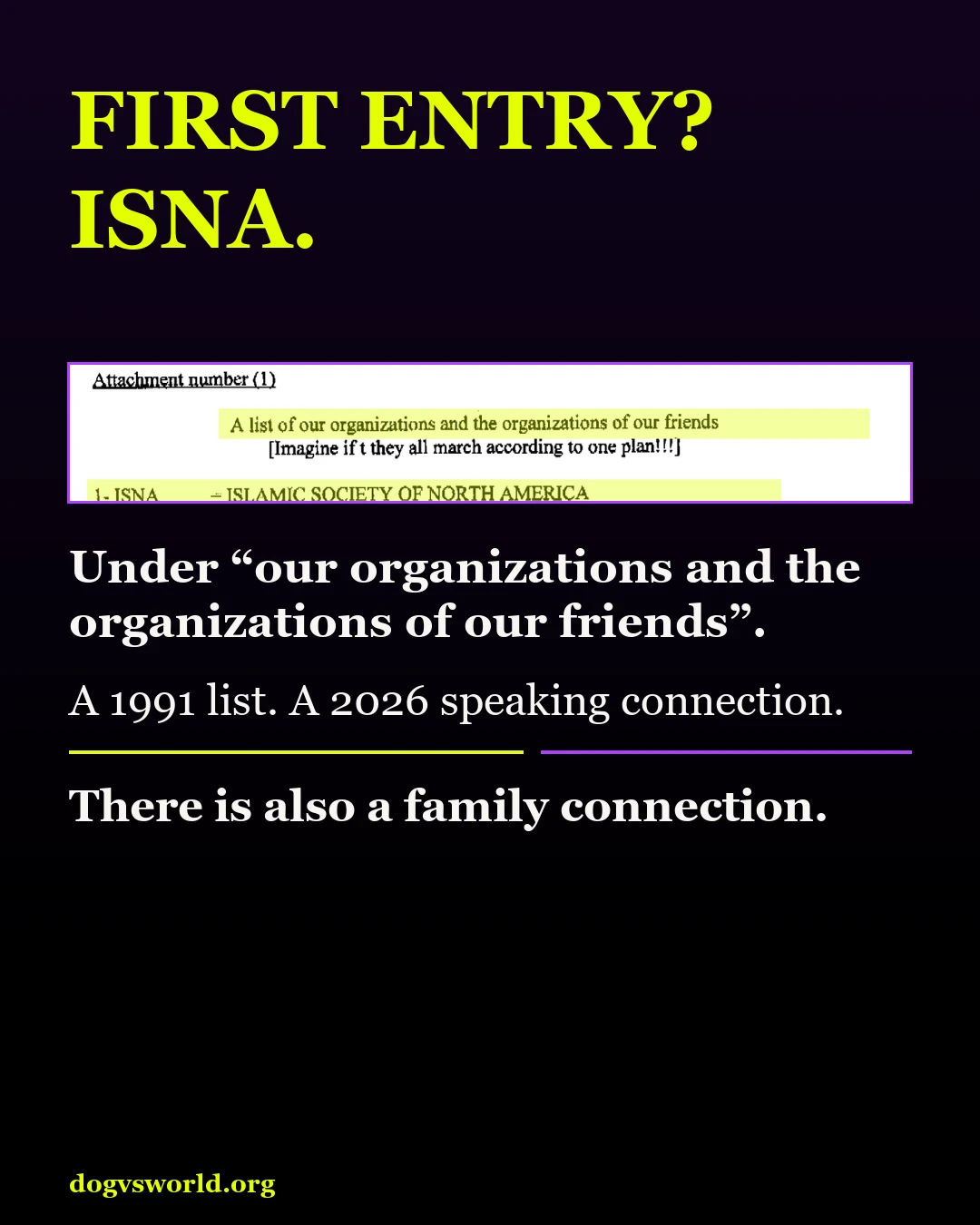
The attachment lists ISNA first under the heading referring to the author's organisations and their friends. The list order is plain. What that establishes about each listed organisation's actual involvement, agreement or present-day governance is a separate question.
The court's July 1, 2009 order identifies the exhibit, authorship and date, quotes the hostile passage and discusses the listed organisations. The record provides historical context and provenance, not a contemporary finding that every speaker at an ISNA event endorses the memorandum.
The family association
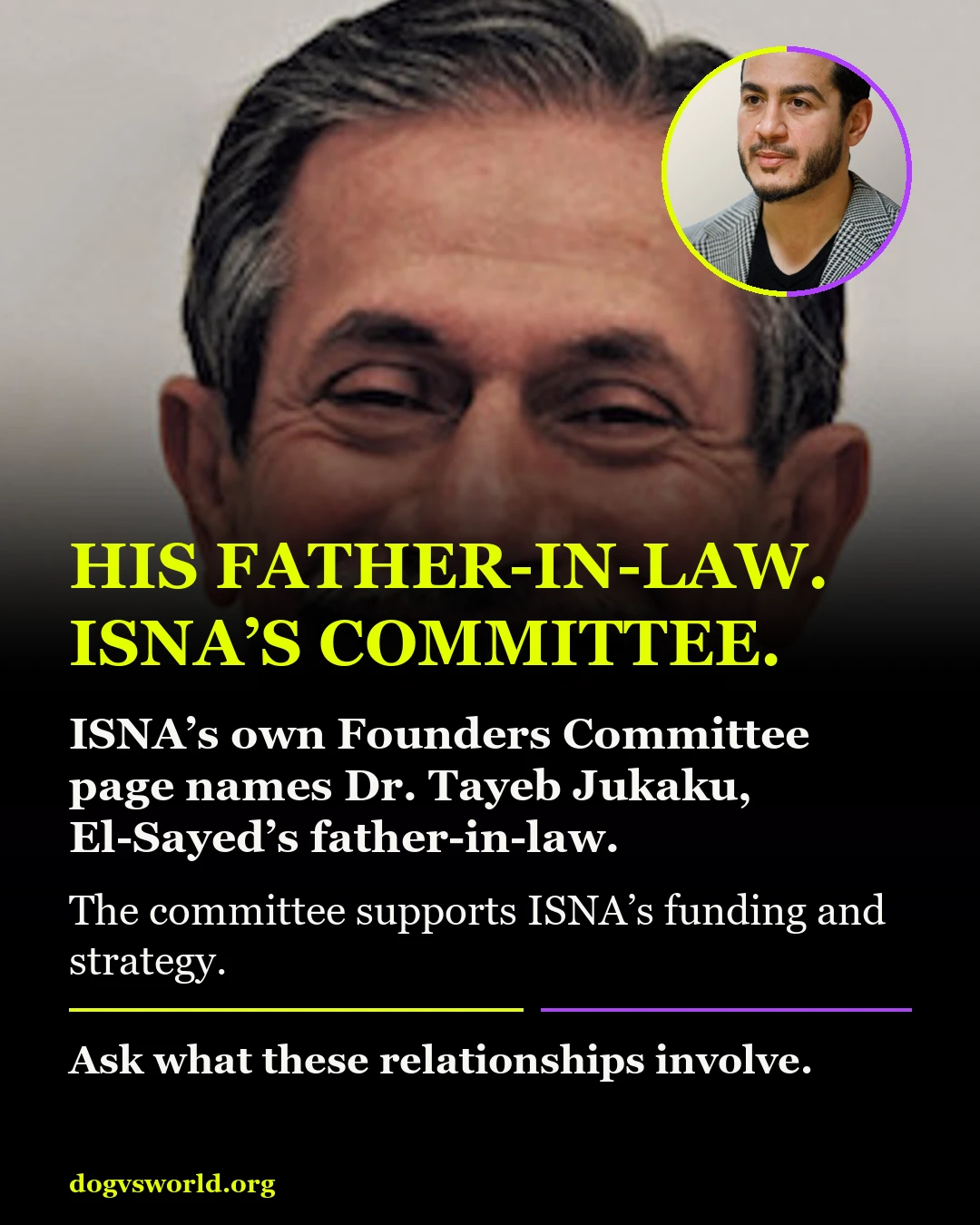
ISNA's published Founders Committee page lists Dr. Tayeb Jukaku, El-Sayed's father-in-law, as a member. The committee's mission includes financial support and advice on stability and strategic priorities. Calling him a committee member is more precise than assigning an unverified leadership office. Membership of a body called the Founders Committee does not by itself mean someone founded ISNA.
ISNA committee listing · Reporting identifying the family relationship
What the responses establish
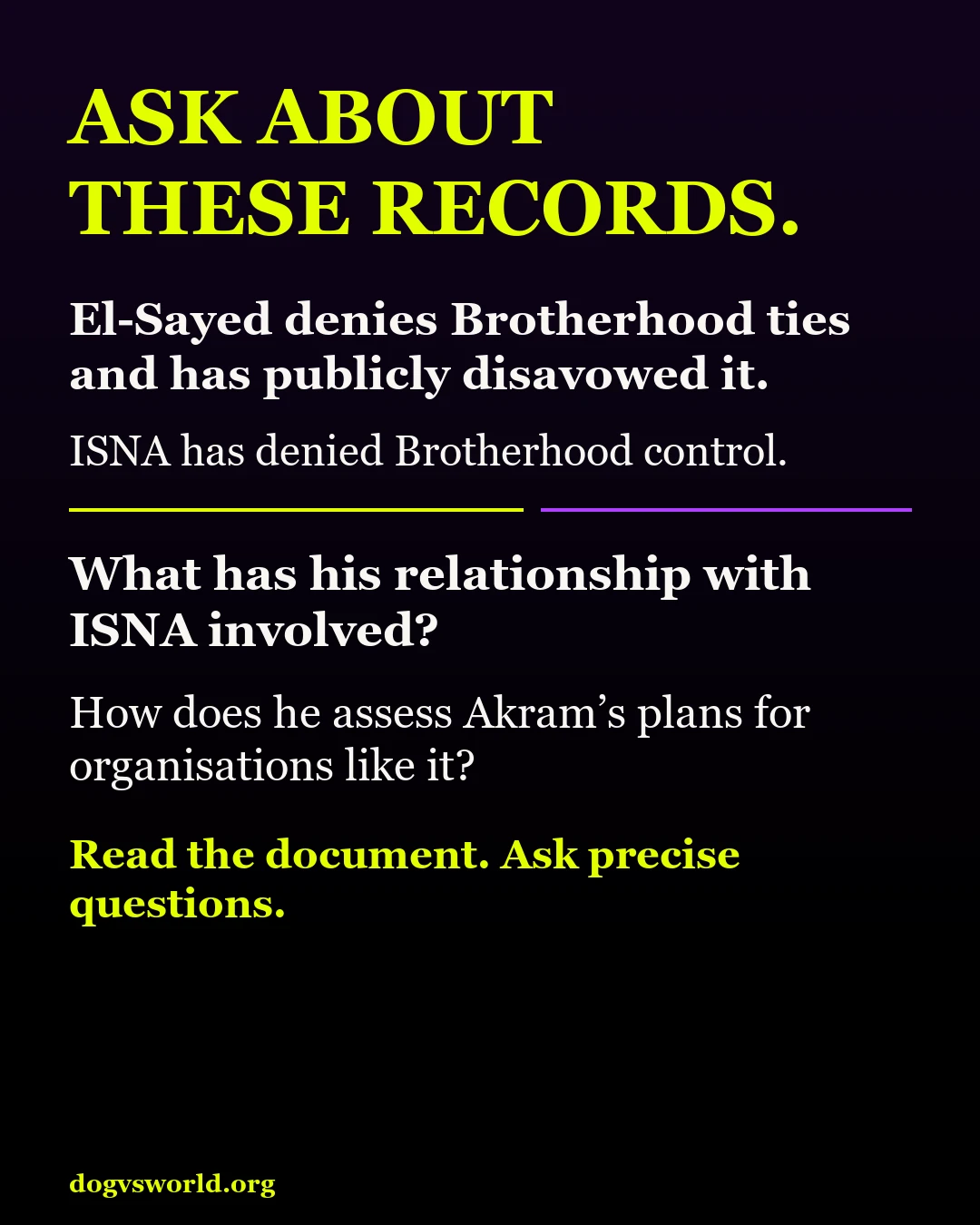
El-Sayed denies Brotherhood ties and has publicly disavowed the movement. CNN's October 19 transcript includes the recorded exchange in which he agrees to disavow it and says the Constitution is his guiding light. ISNA has historically denied being controlled by the Brotherhood; that response is documented in a 2025 study by Lorenzo Vidino.
Recorded response, CNN transcript · Vidino's 2025 study
A family relationship, a speaking listing and a historical document do not establish El-Sayed's endorsement of the author's objectives. They support precise questions about the relationships themselves: what has his association with ISNA involved, and how does he assess Akram's proposed use of organisations such as those named in the attachment?
Those questions can be put without assigning beliefs on the basis of religion, inventing a criminal finding or assuming association means agreement. Readers should inspect the original pages and assess the evidence and responses together.
Keep Doggy investigating

Finding the records, checking the words and making them readable takes time. If you value this work, you can help at buymeacoffee.com/dogvsworld.
Photo credit: Abdul El-Sayed portrait by Kenneth C. Zirkel, CC BY-SA 4.0, Wikimedia source; cropped and colour graded. Tayeb Jukaku portrait from HUDA Clinic. Doggy photograph supplied by the creator. The paw-and-highlighter scene is an illustrative composite from the earlier project; the document excerpts reproduce the actual scan.

Adapted slides incorporating Kenneth C. Zirkel’s portrait are offered under CC BY-SA 4.0; unrelated third-party assets retain their rights. No endorsement by the photographer or pictured people is implied. HUDA Clinic retains rights in its Jukaku portrait.
Check the passages in context
- PDF page 21 / printed English page 7: the passage describing the author’s objective.
- PDF page 26 / printed English page 12: existing institutions as the basis for the proposed project and its guidance language.
- PDF pages 28–31: proposed political, legal, media, educational and other bodies.
- PDF page 32: attachment 1 and its first numbered entry, ISNA.
- Court order, page 15: the court’s discussion of the exhibit and its provenance.
Original Instagram carousel · More exclusive independent research · Corrections and source suggestions.