

The child doesn’t choose the tradition. The child carries the risk. I followed the cousin-marriage research from Pakistan to Bradford.
Family expectations, familiar names and keeping property within the family can explain a marriage choice. They cannot make the genetic questions disappear.
So I looked at the studies behind the carousel: how common the practice is in the populations studied, what happens to children’s health, and what prevention could achieve.
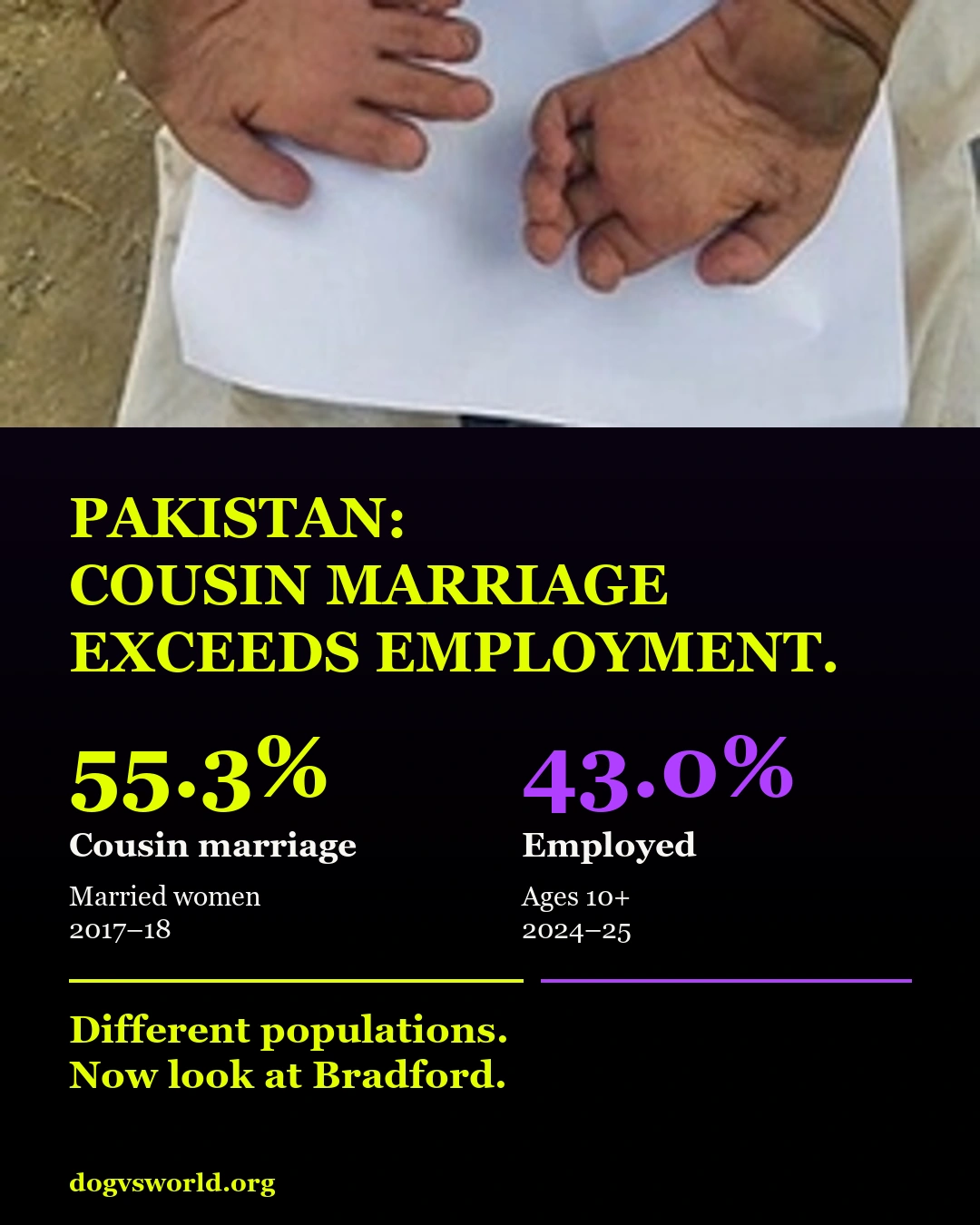
Pakistan: what the opening figures measure
The opening slide places 55.3% cousin marriage beside 43.0% employment. The marriage figure comes from Pakistan’s 2017–18 Demographic and Health Survey, cited in Intensive Kinship, Development, and Demography. The employment figure comes from the 2024–25 Labour Force Survey, covering people aged ten and over under its 19th ICLS framework. [1] [2]
These are different populations and years: married women in the marriage survey, compared with the age-ten-plus population for employment. Subtracting them gives a 12.3-percentage-point numerical gap, but does not measure the probability that the same person marries a cousin rather than works. Including children also affects the employment denominator.
The finding worth following is the persistence of cousin marriage. What does the research show when we follow that question to Bradford?
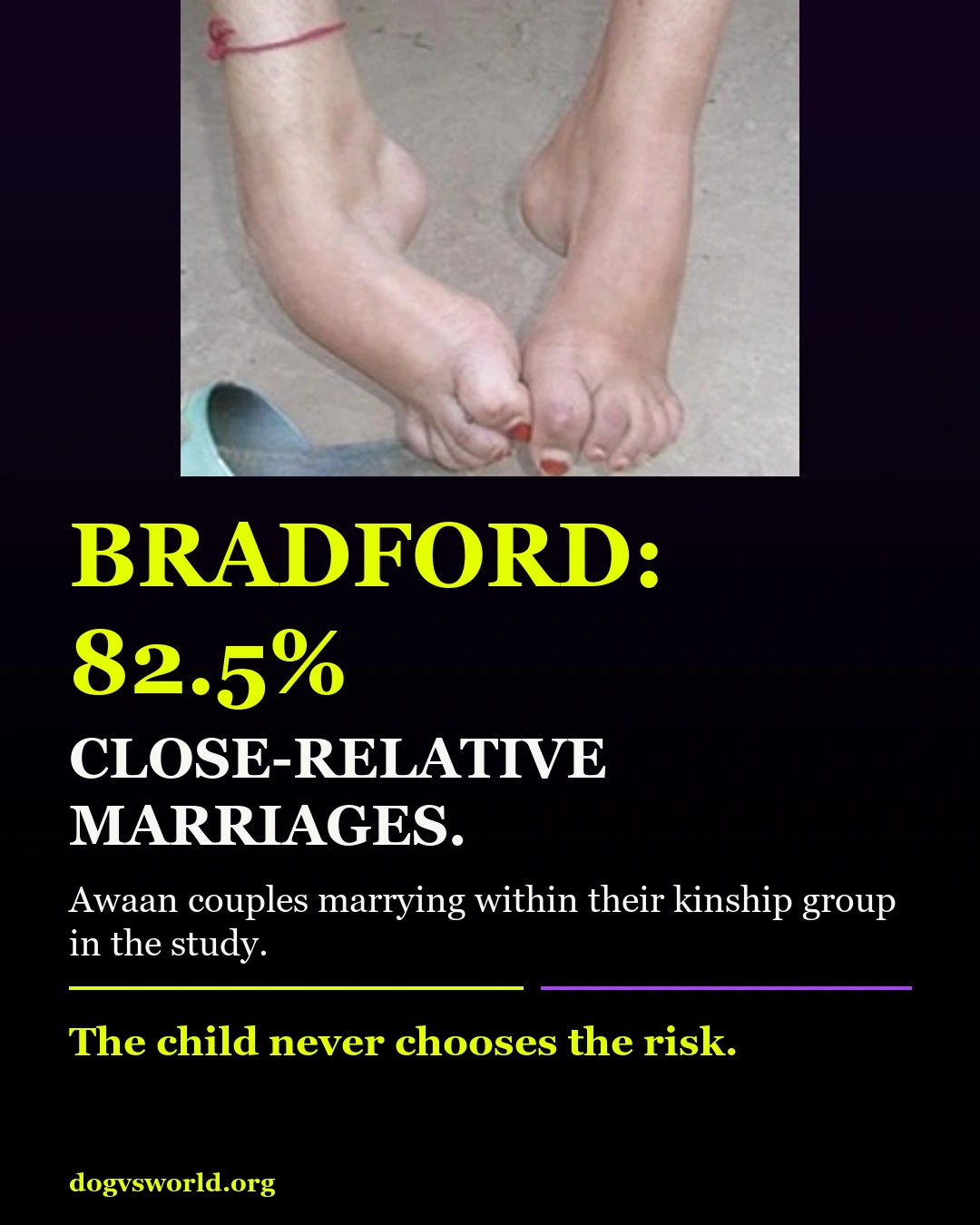
Bradford’s 82.5% finding
The paper Endogamy, consanguinity and the health implications of changing marital choices reports 82.5% consanguineous unions in its Awaan subgroup. Table 4 includes only parents who belonged to the same biraderi, or kinship group. First-cousin marriages accounted for 60.3% of that subgroup’s within-biraderi unions. [3]
This is an older Born in Bradford cohort finding, not a current rate for all Bradford residents or all British Pakistanis. Membership of the same kinship group and a close blood relationship are separate measures. The table’s denominator matters because it tells us exactly whom that striking percentage describes.
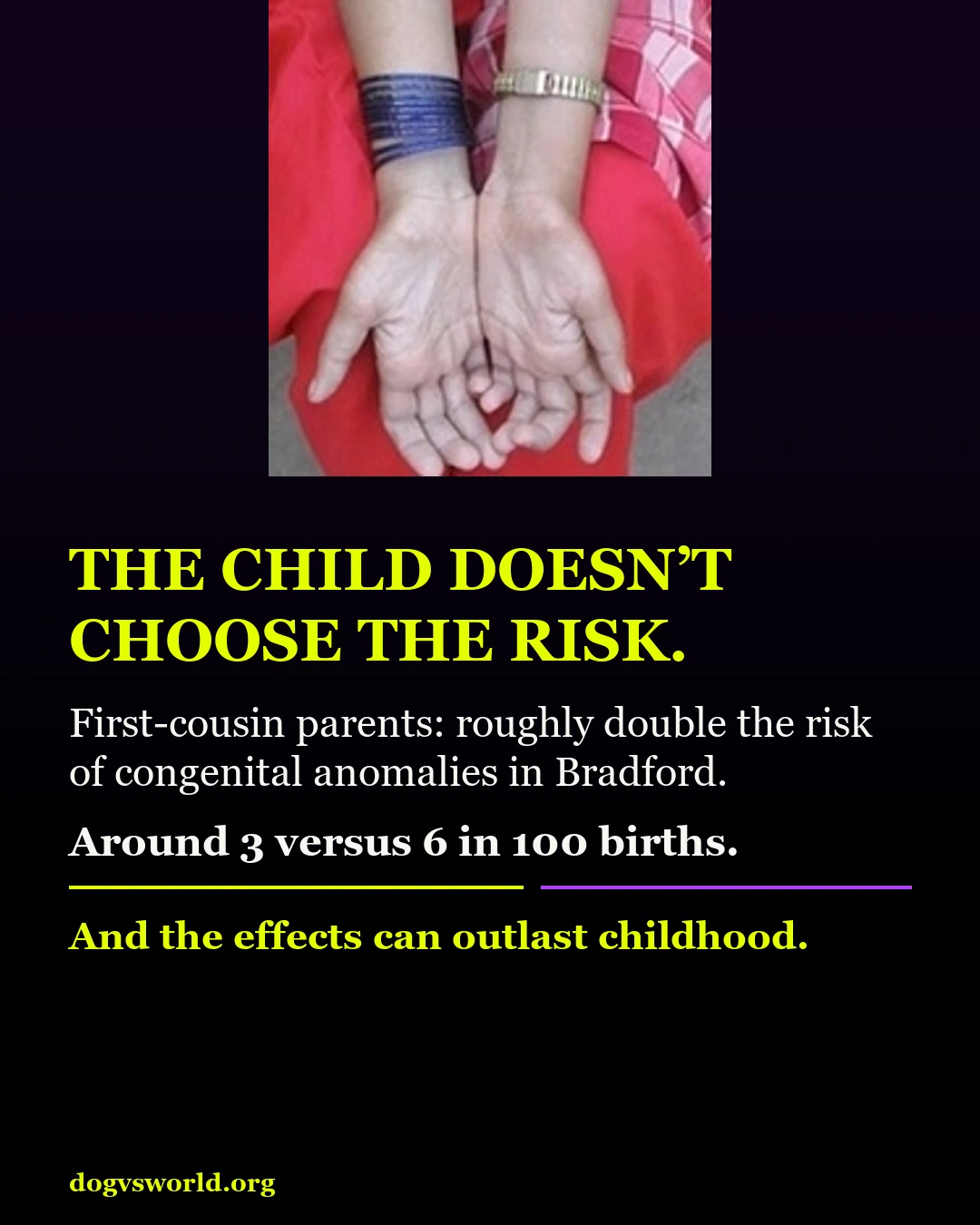
The health risk belongs in the conversation
Born in Bradford’s public findings describe congenital-anomaly risk increasing from approximately 3 in 100 to 6 in 100 births for blood-related parents. That is roughly double the risk, or an increase of three percentage points. Most children in both groups are unaffected, but an increased risk of serious conditions is a clear reason for informed decisions before pregnancy. [4]
Related parents are more likely to share recessive disease variants. Where both parents carry the same autosomal recessive condition, each pregnancy generally has a one-in-four chance of an affected child. That conditional inheritance pattern is different from the overall anomaly rate across cousin couples.
The child does not choose the relationship. Adults and public services can make the information easier to understand and genetic counselling easier to access.
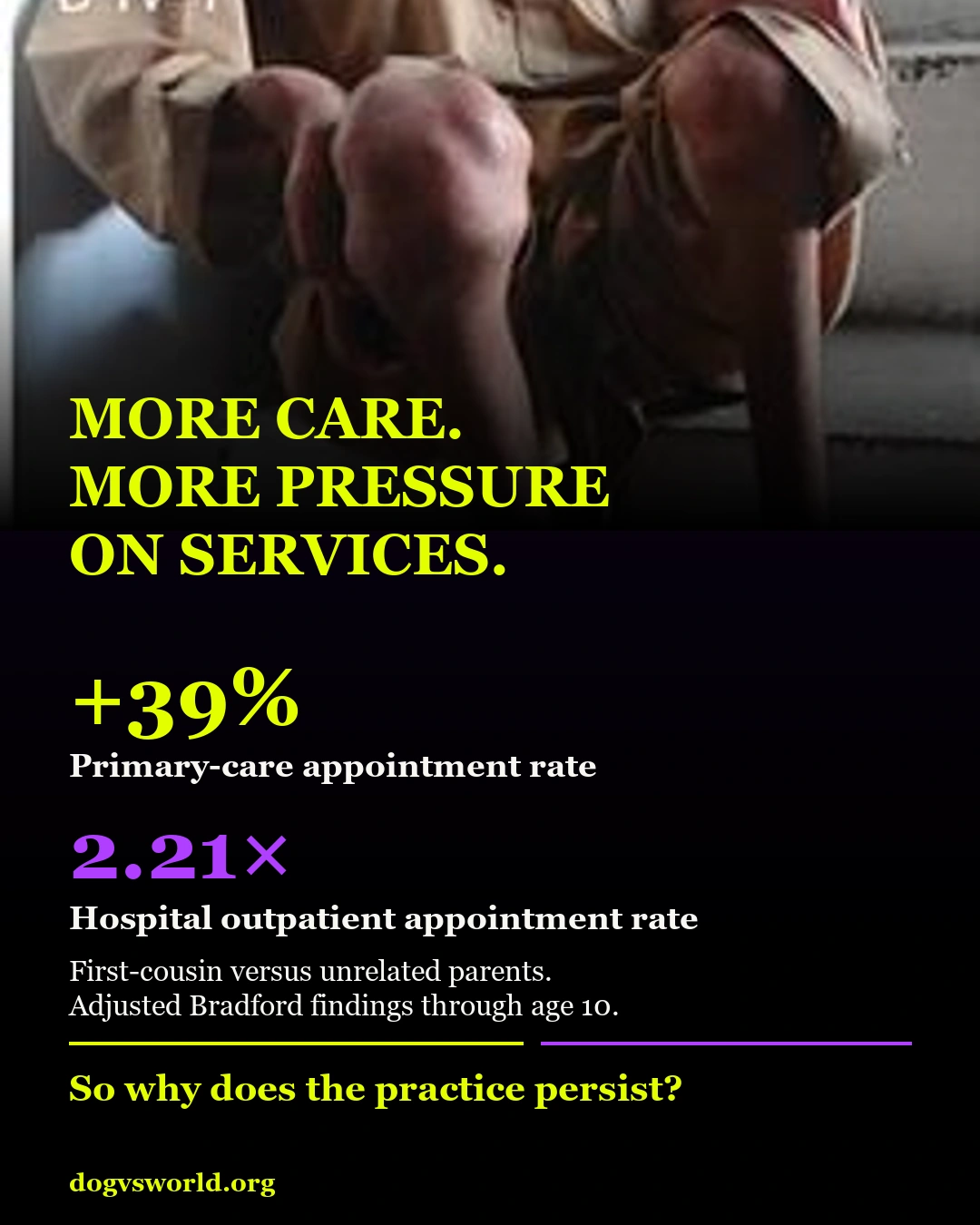
More care, more pressure on services
The follow-up study examined outcomes through age ten. Compared with children of unrelated parents, children of first cousins had an adjusted primary-care appointment-rate ratio of 1.39 and hospital outpatient-event rate ratio of 2.21. [5]
In the carousel, those become 39% higher primary-care use and 2.21 times the outpatient rate. The calculations are straightforward: (1.39 − 1) × 100 = 39%; 2.21 means 121% higher, rather than 221% higher. These are appointment or event rates, not percentages of children attending hospital.
The research also found higher rates of recorded speech/language and learning difficulties. These observational findings strengthen the case for prevention and support. They do not provide a national NHS spending total or a bill that can be calculated from the employment figure on slide one.
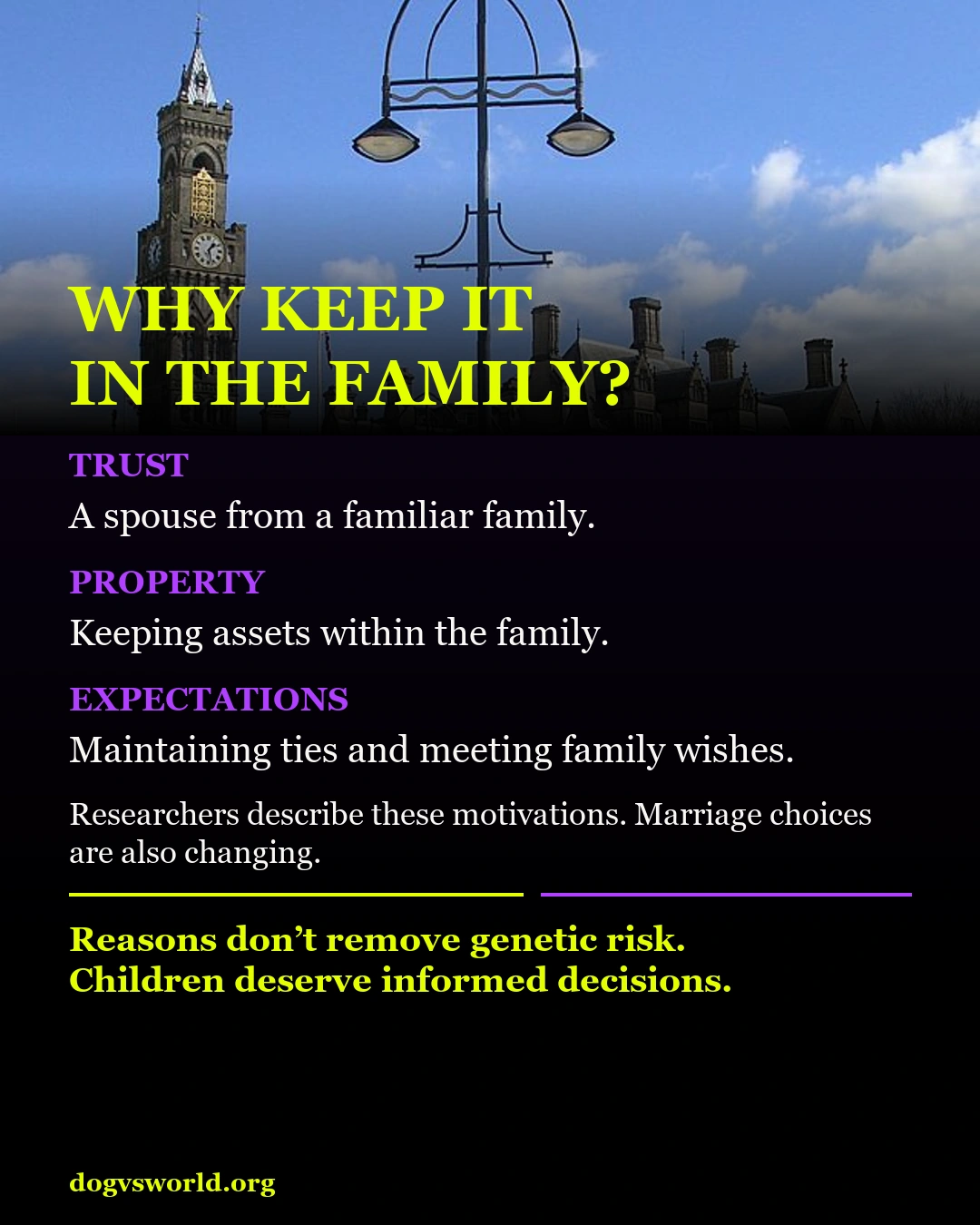
Why keep it in the family?
Qualitative research describes trust in a familiar family, maintaining ties, property and family expectations among the motivations behind marriage choices. Understanding those reasons is useful if prevention is going to reach the people making the decisions. [6]
But a social explanation does not remove a genetic risk. Clear information should be available without families having to go looking for a specialist paper.
Choices are changing. A comparison of two Bradford cohorts found first-cousin parenthood among Pakistani-heritage mothers falling from 39.3% to 27.0%, with other blood relationships falling from 23.1% to 19.3%. Combined, those categories fell from 62.4% to 46.3%, a 16.1-percentage-point reduction between the compared cohorts. [7]
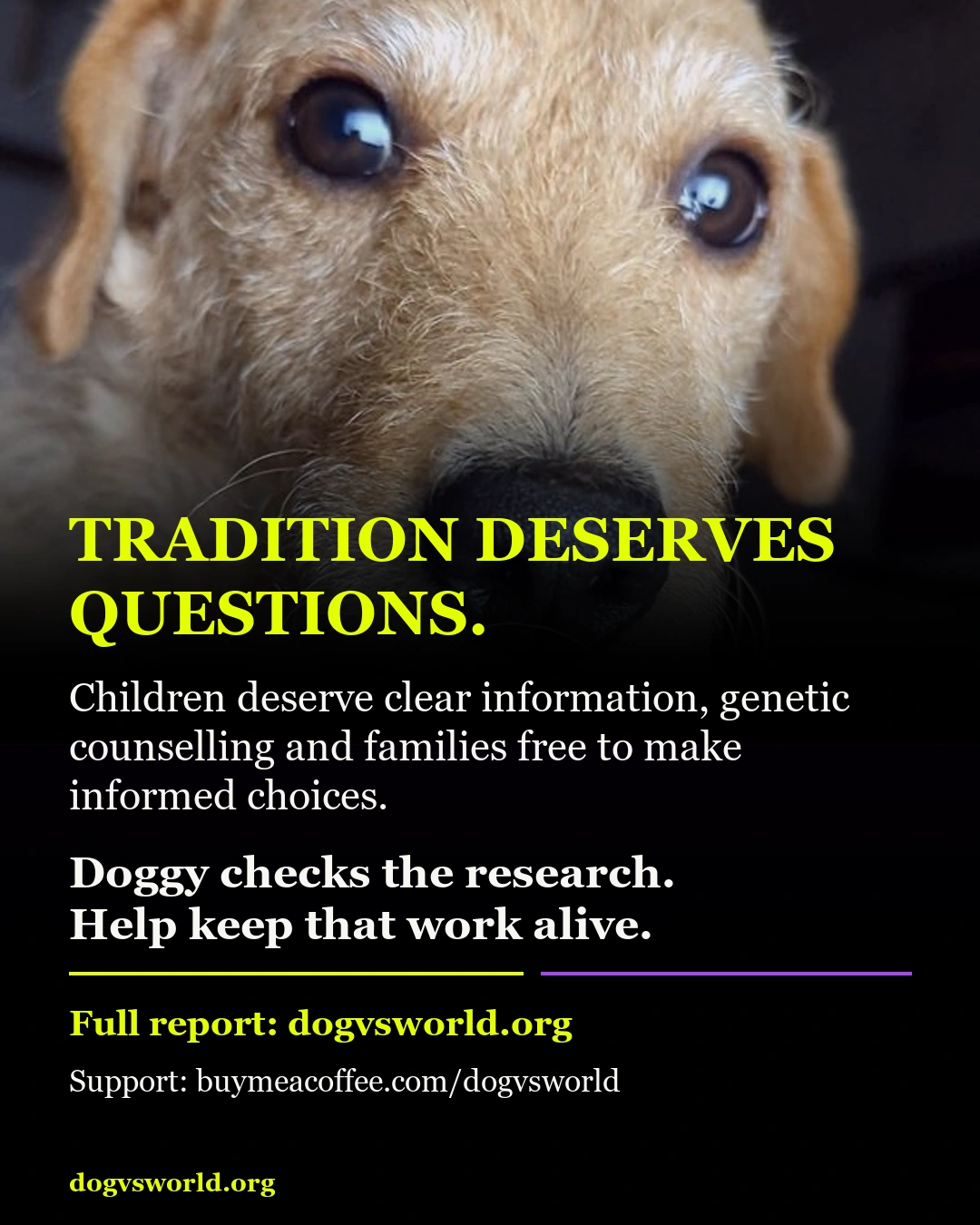
Tradition deserves questions
I want the risks discussed plainly, genetic counselling made accessible, and families able to make informed choices without pressure. Children who need care deserve that care. Preventing avoidable suffering deserves attention too.
Finding the studies, checking the denominators and building these reports takes hours. If you value Doggy’s digging, help keep the research going with a coffee.
What should be done to help families understand these risks before having children?
Clinical photographs and credits
Slides 1–4 use clinical images from Ali and colleagues’ Genetic basis of Charcot-Marie-Tooth disease in Pakistani consanguineous families, Figure 1C. These are separate Pakistani families with childhood-onset neurological disease, not the Bradford participants. The photographs illustrate documented clinical cases; they do not establish the population statistics displayed beside them. [8]
Slides 1–3 show hands or feet of individuals aged 27, 19 and 17 at examination. Slide 4 shows another patient, an adult at examination. The study records consent to publish identifiable images. Its Family A variant was classified pathogenic; novel variants in other illustrated families remained of uncertain significance. The photographs alone cannot establish a particular variant’s causality.
Clinical photographs: Ali et al. (2026), doi:10.3389/fneur.2026.1920139, CC BY 4.0. Cropped, resized and combined with typography and fades; no endorsement implied.
Slide 5: Betty Longbottom, City Hall, taken from the end of Thornton Road, CC BY-SA 2.0. Cropped, colour graded and faded; the adapted slide is available under the same licence. Slide 6 uses my supplied Doggy photograph.

Sources and workings
- Intensive Kinship, Development, and Demography: Pakistan’s marriage-survey figures
- Pakistan Bureau of Statistics: Labour Force Survey 2024–25
- Endogamy, consanguinity and the health implications of changing marital choices: Tables 1 and 4
- Born in Bradford: babies born with serious conditions
- Mortality, morbidity and educational outcomes: adjusted healthcare-use findings
- Changing patterns in marriage choice: qualitative research
- Changes in prevalence and patterns of consanguinity: two Bradford cohorts
- Ali and colleagues: clinical case study and photo source